A new gubernatorial survey by Mwelekeo Insights has placed Independent candidate Oyugi Magwanga firmly ahead in the race for the Homabay governorship, giving him a commanding lead over his closest challenger and offering an early indication of the county’s political direction ahead of the next general election.
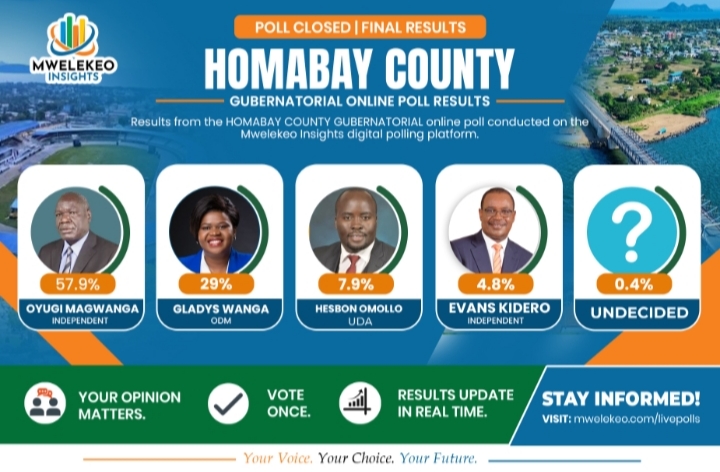
According to the survey, Magwanga enjoys 57.9 percent support among respondents, making him the only candidate to secure backing from more than half of those who participated.
The results suggest that a significant portion of the electorate currently prefers him to lead the county, placing him in a strong position as political activity gradually begins to gather momentum.
While opinion polls do not determine election outcomes, they often provide an important outlook of public opinion at a specific point in time.
The latest findings indicate that Magwanga has established a sizeable advantage over the rest of the field, though campaigns are still expected to intensify in the months ahead.
Wanga Trails as Race Begins to Take Shape
Incumbent Governor Gladys Wanga, who is seeking another term on the ODM ticket, is the second most preferred candidate with 29 percent support.
Although she remains one of Homabay’s best-known political figures and continues to enjoy considerable backing, the survey shows she trails Magwanga by 28.9 percentage points, highlighting the challenge that lies ahead if she hopes to close the gap before voters head to the ballot.
The findings do not suggest that the contest is over. Rather, they reflect the mood of respondents at the time the survey was conducted.
Political campaigns, public debates, party strategies, endorsements, and emerging issues can all influence voter preferences before election day.
Other Candidates
The survey also assessed support for other candidates in the race.
UDA candidate Hesbon Omollo received 7.9 percent support, placing him in third position, while Independent candidate Evans Kidero followed with 4.8 percent.
Only 0.4 percent of respondents said they were undecided, suggesting that most participants already have a preferred candidate.
What the Numbers Suggest
One of the most notable findings is the strength of an Independent candidate in a county that has traditionally been regarded as an ODM stronghold.
Magwanga’s performance suggests that many respondents are looking beyond political party affiliation and placing greater emphasis on individual leadership qualities and development priorities.
For Governor Wanga, the survey presents an opportunity to reassess campaign strategies and strengthen engagement with voters. Incumbents often face greater scrutiny as residents evaluate their record in office alongside promises made by challengers.
The results also indicate that the remaining candidates still have considerable ground to cover if they hope to become competitive. However, Kenyan politics has often demonstrated that campaigns can shift significantly as election day approaches.
Development Remains a Key Issue
As Homabay County prepares for another election cycle, development issues are expected to dominate political discussions.
Residents continue to prioritize better healthcare services, improved road infrastructure, reliable water supply, quality education, youth employment, stronger support for farmers and fishermen, and prudent management of public resources.
These concerns are likely to shape campaign messages and influence voting decisions in the coming months.
Candidates will be expected to present practical solutions while convincing voters that they are best placed to accelerate development and improve service delivery across the county.
Although Magwanga currently enjoys a comfortable lead, maintaining that advantage will depend on sustained engagement with voters.
His competitors will be seeking to narrow the gap through grassroots campaigns, policy proposals, and political mobilization.
About Mwelekeo Insights
The survey was conducted by Mwelekeo Insights, a number one Kenyan public opinion and market research firm that specializes in electoral polling, governance research, public policy analysis, consumer studies, and socioeconomic surveys.
The organization conducts scientific opinion polls designed to measure public sentiment on political and national issues while providing data-driven insights into emerging trends. Its findings represent voter preferences at the time of data collection and should be viewed as a view of public opinion rather than a prediction of the final election outcome.