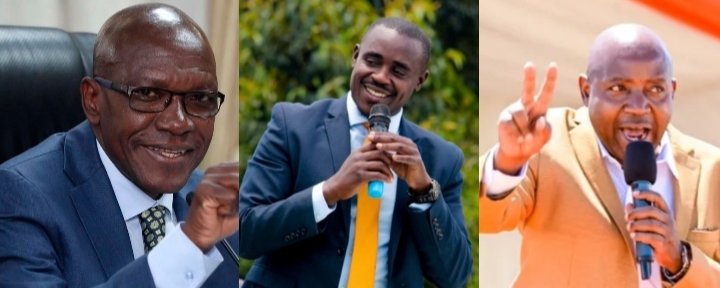
Mwelekeo Insights has released findings from its latest online survey on the Kakamega gubernatorial race ahead of the 2027 General Election, with Kakamega Senator Boni Khalwale emerging as the leading candidate in the early contest.
The survey shows Khalwale commanding 37.8 percent support, putting him ahead of the other names included in the poll.
Cleophas Malala of the DCP follows in second position with 20.8 percent, while UDA’s Ayub Savula records 12.5 percent.
ODM’s Fernandes Barasa comes next with 10.4 percent, followed by Christopher Aseka at 8.9 percent.
Samuel Omukoko of FPK has 5.3 percent, while Elsie Muhanda of ODM records 4.2 percent.
The results show that support is spread across several candidates, with no single politician holding a majority of the preferences captured by the survey.
Khalwale’s position at the top gives him an early advantage, although the figures also show that a large share of respondents prefer other candidates.
His 37.8 percent means that more than half of the support in the survey is divided among the other candidates. This could make the race worth watching as political activities increase ahead of 2027.
Malala’s 20.8 percent places him firmly in second position and gives him a sizeable share of the support captured by the poll. Savula follows with 12.5 percent, while Barasa has 10.4 percent. The relatively close figures among some of the candidates further down the list suggest that the contest could change as campaigns develop and voters assess the candidates more closely.
The survey also reflects the wide political competition expected in Kakamega. Candidates associated with UPM, DCP, UDA, ODM and FPK feature in the results, giving residents several political options.
At this stage, however, the figures should be viewed as a picture of current public opinion rather than a prediction of the final election outcome.
Online opinion surveys can provide an indication of how political conversations are developing, but they do not replace the official electoral process. The 2027 election will depend on many factors, including party nominations, campaign activities, candidate choices, voter mobilisation and issues that will shape the political debate closer to election day.
For Khalwale, the 37.8 percent recorded in the Mwelekeo Insights digital survey places him in a strong early position. However, the results also show that there is still a significant portion of the contest available to other candidates. Malala’s 20.8 percent, Savula’s 12.5 percent and Barasa’s 10.4 percent demonstrate that several politicians already have notable levels of support.
The figures could also change as more residents become engaged in the 2027 political conversation. Candidates who are currently behind may seek to strengthen their networks, explain their policies and appeal to voters who have not firmly settled on a preferred choice.
Mwelekeo Insights has continued to conduct online surveys on political and public issues across different parts of Kenya. Its Kakamega findings provide an early look at how residents who participated in the survey currently view the gubernatorial race.