

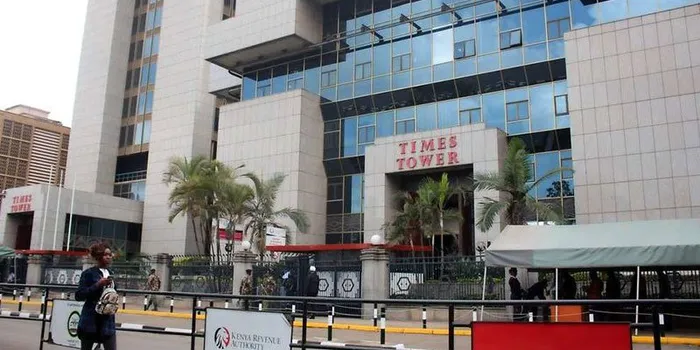
The scale of the gap between what China says it exports to Kenya and what Kenya records as imports has raised serious questions about the country’s customs systems and revenue collection.
Official figures show that in 2025 alone, China exported goods worth Sh1.3 trillion to Kenya. However, the Kenya Revenue Authority (KRA) recorded imports worth only Sh672 billion from China during the same period. This leaves an unexplained difference of Sh629 billion, a figure too large to be dismissed as a simple reporting error or administrative mistake.
The concern becomes even greater when viewed over a longer period. Between 2021 and December 2025, Chinese customs records indicate that goods worth Sh5.35 trillion were shipped to Kenya.
In contrast, KRA recorded imports worth only Sh2.587 trillion. The cumulative gap over five years now stands at Sh2.76 trillion. The pattern has remained consistent, with a shortfall of Sh723 billion recorded in 2023, Sh533 billion in 2024, and Sh629 billion in 2025. Such repeated discrepancies point to a deep-rooted problem that has persisted despite years of warnings and public scrutiny.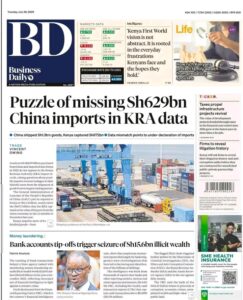
Customs revenue is one of the most important sources of government income. In the nine months ending March 2026, KRA collected Sh733.7 billion from customs duties and related taxes, accounting for about 36 percent of total tax revenue.
When goods worth hundreds of billions of shillings appear to enter the country without being fully captured in official records, the impact on public finances is significant. Every missing shilling represents money that could have been used to improve schools, hospitals, roads, water projects, and other public services that millions of Kenyans rely on every day.
Experts have repeatedly pointed to under-declaration, false invoicing, and deliberate undervaluation of imported goods as likely causes of the problem. Electronics, clothing, machinery, and other high-volume imports are often cited as products vulnerable to manipulation.
In normal circumstances, Kenya’s import figures should actually be higher than China’s export figures because Kenyan records include additional costs such as freight and insurance.
The fact that the opposite is happening year after year strengthens concerns that substantial leakage exists within the system.
The responsibility for addressing this problem rests heavily on KRA’s leadership. The authority oversees customs operations at ports, airports, and border points.
It manages valuation systems, intelligence units, and enforcement teams tasked with detecting fraud and ensuring compliance. When a discrepancy of this magnitude continues for five consecutive years, it raises difficult questions about the effectiveness of oversight mechanisms and the commitment to stopping revenue losses.
Many Kenyans may find it frustrating that while the government continues to introduce new taxes and increase levies to boost revenue, such a massive gap remains unresolved.
Salaried workers face deductions from their monthly earnings, businesses are required to comply with strict tax regulations, and consumers bear the burden of higher costs. At the same time, billions of shillings in potential customs revenue appear to slip through the cracks.
The Treasury has previously announced plans to strengthen cooperation with foreign tax authorities and increase scrutiny of high-risk imports.
Yet the numbers suggest that these measures have not delivered the desired results. The gap remains stubbornly large, and the losses continue to accumulate.
This is no longer a technical issue buried in customs reports. It is a matter of national concern that affects government revenue, public services, and taxpayer confidence.
The figures tell a troubling story, and they point to a challenge that can no longer be treated as business as usual.