

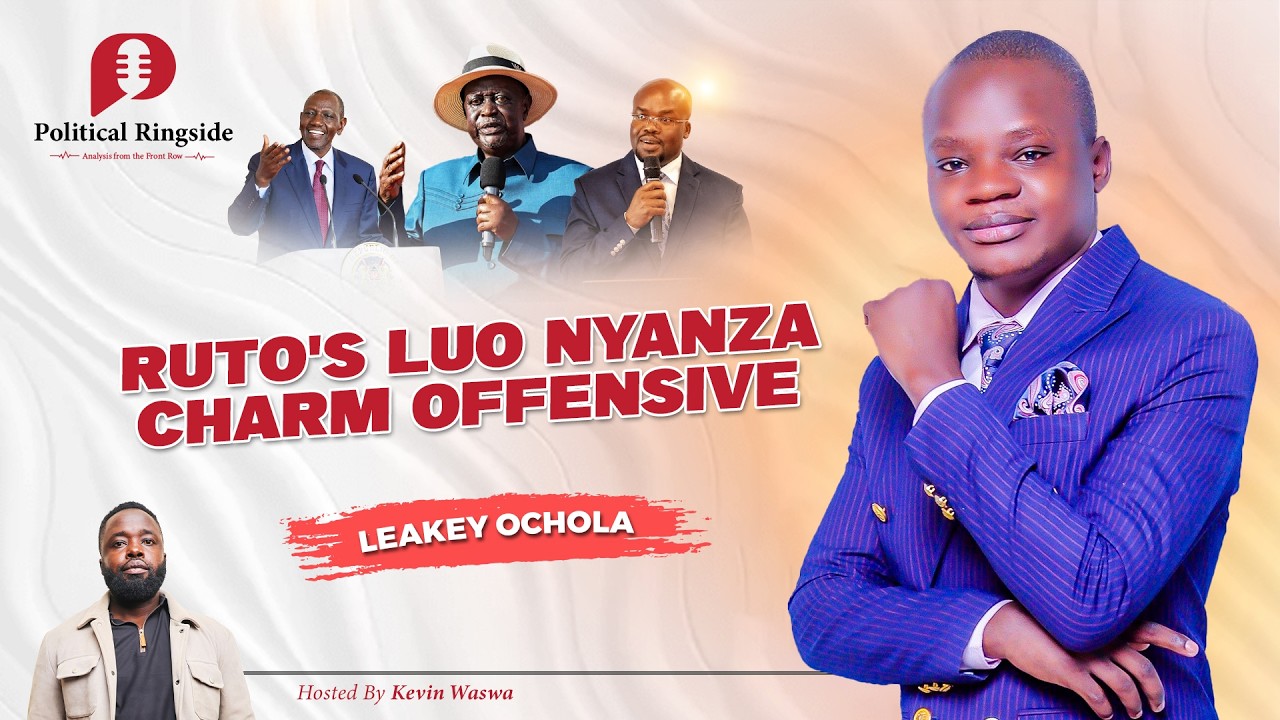
Political Ringside recently hosted a discussion where Kevin Waswa sat down with youth political commentator Leakey Ochola to examine the shifting political landscape in Nyanza and President William Ruto’s growing influence in the region.
Ochola opened up about his personal journey, explaining that he comes from a humble background as the son of a tailor. After losing an election while in campus, he made a deliberate choice to rebuild his identity and step away from expectations tied to his past.
The discussion centered on Ruto’s recent moves in Nyanza. According to Ochola, the president is taking a calculated approach by visiting the region and promoting development projects. While some residents see this as a positive step toward inclusion, others question the timing and intention. Ochola argued that this could be a strategy to weaken traditional opposition support and attract new voters, especially at a time when the region is experiencing political uncertainty.
Much of that uncertainty, he noted, comes from changes within ODM following the passing of Raila Odinga. Ochola suggested that the party has struggled to maintain strong internal systems, relying more on personalities than firm structures.
He compared this to parties like ANC in South Africa and CCM in Tanzania, which have managed to remain stable beyond individual leaders. In his view, ODM’s current challenges make it more vulnerable to outside political pressure.
The conversation also addressed the idea of a broad-based government formed after the 2022 elections. Ochola expressed doubt about its long-term strength, saying such arrangements often feel temporary and may not fully represent the will of the people.
He pointed out that not everyone in Nyanza supports these alliances, despite assumptions that the region moves as one.
On the issue of zoning in politics, Ochola was clear in his opposition. He argued that dividing regions to avoid competition limits democracy and denies voters the chance to choose leaders based on merit.
He believes elections should be open and competitive, allowing the best candidates to rise through performance and ideas rather than agreements behind the scenes.
Youth involvement was another key theme. Ochola said young people are becoming more aware and are less likely to follow traditional political patterns. They are now focusing more on leadership qualities, accountability, and real solutions to everyday challenges like unemployment and inequality. He noted that this shift could reshape voting behavior in the coming years.
The discussion also touched on government performance. Ochola acknowledged efforts such as the new health insurance plan and changes in university funding, which aim to support ordinary citizens.
However, he criticized areas like affordable housing and youth funding, saying they have not fully addressed the real needs on the ground. Small financial support, he argued, cannot solve larger economic problems.
When speaking about Ruto, Ochola described him as a skilled and strategic politician who understands how to navigate complex political situations.
He suggested that the focus on Nyanza could also be part of early preparations for the 2027 elections. He also warned that the growing awareness among young voters could make political outcomes less predictable.
Ochola also raised concerns about human rights and the value of life, noting that how a government handles such issues affects public trust.
He stressed that leadership should prioritize the protection and dignity of citizens, as this forms the foundation of any stable society.
He reflected on the legacy of past leaders and the need for a new generation to build on those values while introducing fresh ideas. He expressed interest in joining elective politics in the future, focusing on simple and practical leadership that addresses real needs.
The Political Ringside conversation reveals a region in transition. Nyanza is no longer defined only by past loyalties but is increasingly shaped by new political strategies, internal party challenges, and a more questioning youth population.