

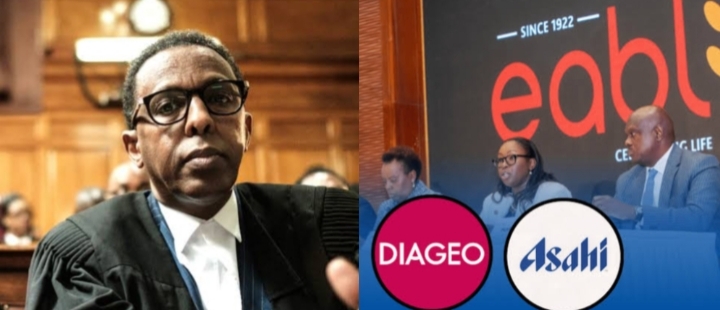
Senior Counsel Ahmednasir Abdulahi, a prominent Kenyan lawyer, has ignited a fierce debate with his recent, blunt assessment of the stalled multi-billion-shilling acquisition involving East African Breweries Limited (EABL). In a post on social media, Ahmednasir directly addressed Asahi Group Holdings of Japan and Diageo of the UK, the two international giants attempting to acquire a 65% stake in EABL for a staggering Kshs 340 billion.
His message was stark and provocative: to overcome the “endless litigation and regulatory roadblocks” that have plagued the deal, the companies should simply pay a bribe.
This statement, whether taken as cynical humor or a serious indictment, has pulled back the curtain on a frustrating reality for many investors in the region, highlighting a persistent perception that major business transactions cannot proceed without a “cut” for certain influential parties.
The core of the issue lies in the massive financial scale of the deal, which has made it a lightning rod for legal and bureaucratic hurdles.
In Kenya, and many other parts of the world, a project of this size inevitably attracts intense scrutiny.
However, Ahmednasir’s comment suggests that this scrutiny is not purely about protecting public interest or ensuring fair competition. Instead, he implies that the “regulatory roadblocks” are a deliberate strategy, a way for some actors to create a bottleneck that forces the deep-pocketed multinationals to negotiate with them directly.
This creates a system where the official channels become congested, and the unofficial, costly “facilitation” fees become the only way to move forward.
The deal, which could reshape the East African alcohol industry, has been stuck for months, and this public outburst has vocalized a private frustration many in the business community share.
This situation serves as a critical test for Kenya’s investment climate. On one hand, the country has made legal and regulatory progress to attract foreign direct investment.
On the other, the persistent narrative of corruption, as voiced by a prominent lawyer like Ahmednasir, sends a chilling signal to global corporations. When a deal worth hundreds of billions of shillings is perceived to be held hostage by the demand for illicit payments, it undermines trust in the entire system.
It creates a “Kenya bwana” mentality, as Ahmednasir put it, suggesting that business must be conducted in a particular, and often corrupt, manner.
This is more than just a commentary on one deal; it is a reflection on the structural challenges that continue to deter transparent business practices.
The path forward for this EABL acquisition, and for Kenya’s economic reputation, lies in a clear choice. The government and its regulatory bodies must work to ensure that all processes are transparent, predictable, and free from external manipulation.
The perception that legal and regulatory frameworks are merely bargaining chips for personal enrichment must be actively dismantled.
For Asahi and Diageo, the road ahead is uncertain, but the suggestion that they should pay a bribe is not a solution; it is a symptom of a deeper problem that requires systemic change.
The controversy surrounding the stalled EABL acquisition took a new and troubling turn when Justice Mong’are, sitting in Machakos, issued an injunction against a case that was already being handled in Nairobi, a procedural move that many legal observers saw as a blatant forum-shopping tactic designed to frustrate the main proceedings.
This decision by Justice Mong’are, who has faced repeated and public calls for her removal over corruption allegations from lawyers like Nelson Havi, has added another layer of complexity and suspicion to a deal already mired in claims of bribery and regulatory manipulation.
For critics like Ahmednasir Abdulahi, who bluntly suggested that the international companies involved should simply pay bribes to overcome the roadblocks, the Machakos injunction serves as a perfect example of the judicial dysfunction that makes such cynical advice seem almost logical.
The sight of a judge from a different county inserting herself into a matter that belongs in Nairobi, especially one with a track record of corruption accusations, only reinforces the narrative that Kenya’s courts are being weaponized to extract personal benefits from high-stakes commercial deals.