
Kenya has taken a major step towards becoming an oil-producing country after drilling operations officially commenced in Turkana County, with the government projecting revenues of more than KSh371 billion over the next 25 years.
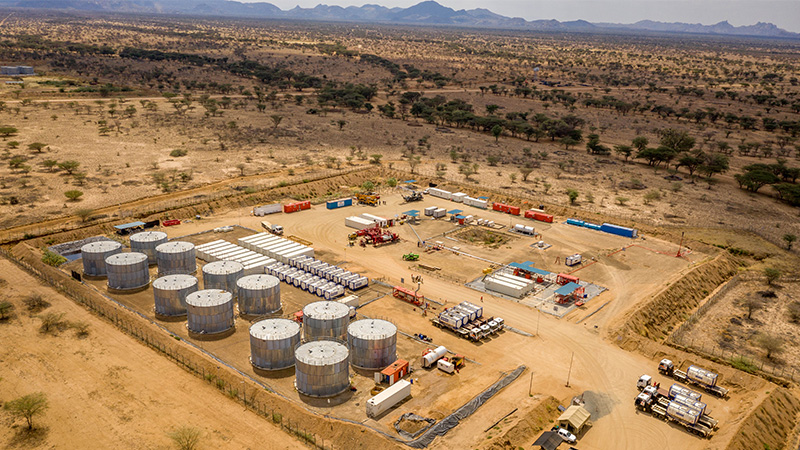
The drilling exercise began on Friday, November 20, at the Amosing 1 well pad in the South Lokichar Basin, marking progress towards the commercial exploitation of the country’s crude oil reserves.
Gulf Energy E&P BV SEZ, the government’s contractor, is undertaking the operation using an onshore drilling rig leased from China’s Great Wall Drilling Company.
Energy Cabinet Secretary Opiyo Wandayi presided over the spudding ceremony, which marks the initial stage of drilling a well. During the event, he announced that the government was targeting December 1, 2026, for the commencement of the first oil production.
The initial production phase is expected to deliver approximately 20,000 barrels of crude oil daily from four oil fields collectively known as NEAT. These comprise Ngamia, Amosing, Twiga and Ekales.
The government estimates that the project could generate more than USD2.9 billion, equivalent to approximately KSh371 billion, during its 25-year contract period. However, the actual revenue will depend on international crude oil prices and the volumes produced throughout the project’s lifespan.
Wandayi described the commencement of drilling as a significant milestone in Kenya’s efforts to move from oil exploration to actual production.
“This spudding event by the Government of Kenya’s contractor, Gulf Energy E&P BV SEZ, marks a historical milestone ahead of first oil production,” Wandayi said.
The current operations form part of a wider development plan covering oil discoveries in Blocks T6 and T7 within the South Lokichar Basin. The government is supporting the development of the fields as it seeks to accelerate the production process and establish a commercial oil industry.
Gulf Energy Managing Director Paul Limoh said the company was working within its planned schedule and remained committed to beginning production on December 1.
According to Limoh, the first crude oil volumes will initially be transported by road from Turkana to Mombasa, where they will be stored at the Kenya Petroleum Refineries Limited (KPRL) tank farms.
The company is also planning to increase production to 50,000 barrels per day during the second phase of the project, representing a substantial rise from the initial target of 20,000 barrels daily.
Limoh said Gulf Energy was maintaining its project management and delivery timelines while working with relevant stakeholders to ensure the development meets the required standards.
“At Gulf Energy, we are maintaining a tight delivery and project management schedule with the support of all our stakeholders, with a pledge to deliver against the FDP to world-class standards,” he said.
The South Lokichar Basin contains six oil discoveries with an estimated recoverable volume of 326 million barrels, according to the government’s development plan. The reserves are expected to support production over the project’s projected 25-year period.
Beyond oil extraction, the government is also undertaking infrastructure development in Turkana to support operations and improve connectivity in the region.
Transport Cabinet Secretary Davis Chirchir announced that the government was investing more than KSh24 billion in roads and other infrastructure in the oil-producing region.
The investment is expected to support the movement of equipment, workers and crude oil while improving access to areas surrounding the oil fields.
The commencement of drilling therefore marks an important stage in Kenya’s long-running efforts to develop its petroleum resources, with the government now working towards the targeted December 1 start of first oil production.