

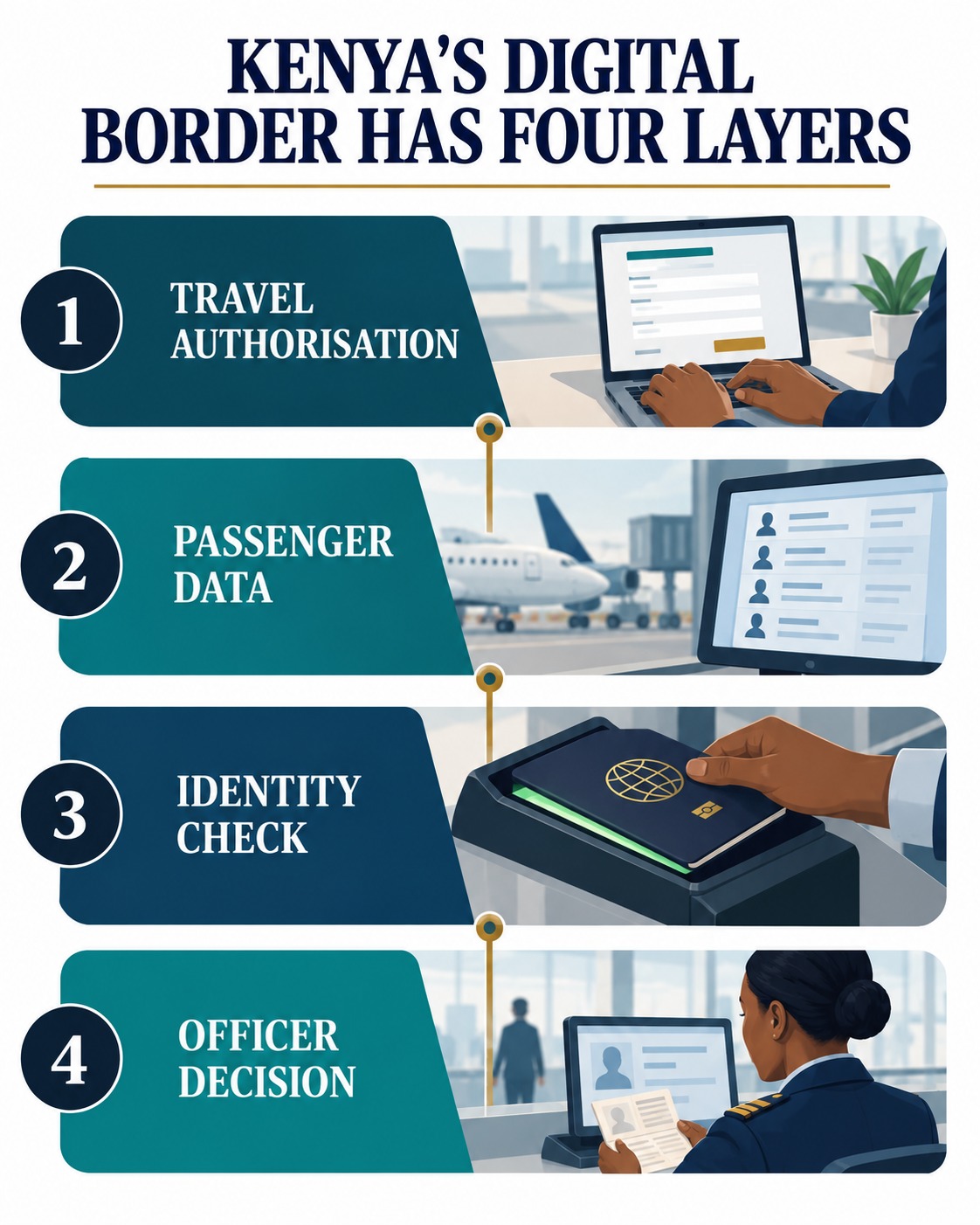
Kenya’s digital travel process is often described as though one online system decides who enters the country. In reality, several different processes take place between planning a journey and crossing the border. Understanding those layers helps travellers prepare, helps officials explain the service and prevents one technical problem from being mistaken for failure of the entire border system.
The four main layers are travel authorisation, passenger data, identity verification and the immigration officer’s legal decision.
 Travel authorisation happens before the journey
Kenya’s Directorate of Immigration Services describes the electronic travel authorisation, or eTA, as the government’s online process for visitors who require approval before travel. The official platform says it is a semi-automated system that determines eligibility to travel. It also states that an approved eTA is not final authority to enter Kenya; admissibility is determined at the point of entry.
That distinction is important. An eTA is a pre-travel permission, not an electronic border stamp and not a guarantee of admission. Its purpose is to collect required information early enough for review and to tell the traveller whether the journey may begin.
Airlines transmit a different set of records
Airlines create operational records when a passenger books and checks in. Advance Passenger Information normally contains identity and travel-document details captured around check-in. Passenger Name Record data comes from the reservation process and may include itinerary and booking information.
ICAO, the World Customs Organization and IATA maintain common standards for transferring these data to authorised government units. The standards exist so that every airline does not need a different technical language for every destination.
Passenger data supports pre-arrival checks, but it is not the eTA application and it is not the physical examination of the traveller.
Identity checks occur at the border
At an immigration desk or eligible automated gate, the system reads the travel document, tests security features and may compare the traveller’s face with the portrait stored in the electronic passport. If the document cannot be read, the biometric comparison is uncertain or a rule requires further review, the traveller is referred to an officer.
This is normal system design. A referral is a controlled path for resolving uncertainty, not a finding that the traveller has committed an offence.
An authorised officer owns the final decision
The public authority defines the country’s entry rules and makes the legal decision. Technology suppliers may build or support eTA platforms, passenger-data gateways, document readers, biometric engines, eGates and case-management tools. Those services are offered internationally by multiple companies, including SITA, IDEMIA, Thales, NEC and Securiport.
The commercial system can organise information and present alerts. It should not obscure who has lawful authority to act. Clear interfaces and public notices should identify the responsible government office, the route for correcting an error and the process for travellers who cannot use automation.
Data protection applies across every layer
Each layer uses different information for a different purpose. That means the data controller should define what is collected, why it is needed, who may access it, how long it is retained and what happens when another agency or service provider processes it.
Kenya’s Office of the Data Protection Commissioner says biometric data is sensitive and provides guidance on impact assessments, public-sector processing and cross-border transfers. A digital border programme should therefore maintain an information map that follows the traveller’s data across the eTA platform, airline exchange, border checkpoint and any authorised secondary review.
Better explanations improve the service
Passengers need a simple sequence: apply through the official channel, receive the travel decision, carry the required document, complete airline checks and present for examination on arrival. Officials need a more detailed operating map that identifies the owner of each decision and each dataset.
When those layers are separated, public debate becomes more accurate. A delayed eTA application can be investigated as an application-service issue. A passport-chip problem can be handled at the checkpoint. An airline data error can be corrected at its source. A legal admissibility question goes to the authorised officer.
Kenya’s digital border is not one machine. It is a chain of decisions, records and safeguards. The system works best when each link is named and measured.
Sources
- Directorate of Immigration Services electronic travel authorisation service
- Official Kenya eTA declaration and data-use notice
- ICAO API Guidelines and PNR Reporting Standards
- Office of the Data Protection Commissioner guidance notes