
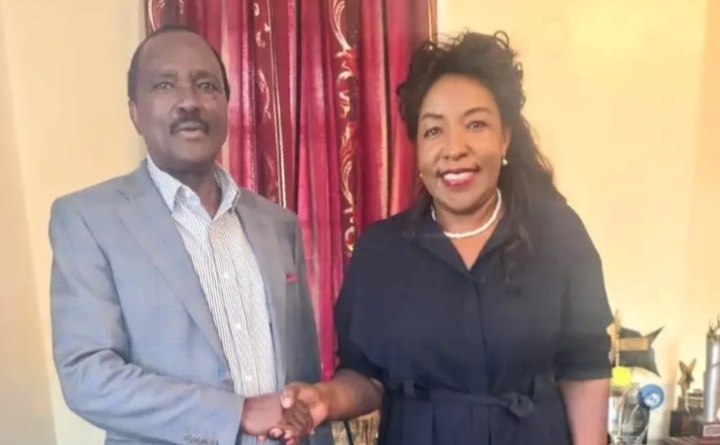
Agnes Kagure recently met former Vice President Kalonzo Musyoka to discuss issues affecting the country, and she later spoke openly about the meeting. Sharing details on social media in January 2026, she said the talks focused on matters of national importance and leadership.
Kagure used a strong personal message to describe her political journey, saying, “I am like a small but powerful dynamite that will soon break through big challenges in Nairobi.” She added the Swahili phrase, “Dawa ya Nairobi ni Mama, na Nairobi ni Mama wezesha,” to explain her belief that Nairobi needs caring and practical leadership that empowers its people.
Kagure’s path into politics has been shaped by her life story. She was born into a family of 11 children and grew up in a home where resources were limited. At 19, she moved to Nairobi to look for opportunities and escape hardship.
Life in the city was not easy, but she slowly built herself through hard work and determination. Over time, she became a successful businesswoman and served on the boards of different companies. Her experiences in business and community work pushed her to take a more active role in public leadership.
In 2022, Kagure announced her bid for the Nairobi governor seat. She campaigned on a five-point agenda that focused on improving daily life for city residents, including services and opportunities.
Although she did not win, she remained active and did not step back from politics. She later became the leader of the Kenya Patriots Party and has continued to prepare for the 2027 elections.
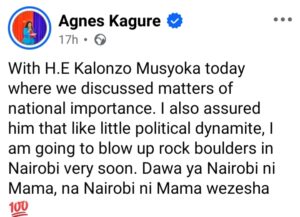
Screen grab from the post shared by Agnes Kagure on Facebook.
Kagure has clearly stated her desire to become the first female governor of Nairobi. Her party has been gaining attention, especially among young people, and she often talks about the need to include youth and women in leadership roles.
Kalonzo Musyoka is a long-serving figure in Kenya’s opposition politics and the leader of the Wiper Democratic Movement. He has been speaking strongly about the need for change, especially as many Kenyans struggle with high living costs and weak public services.
Towards the end of 2025, Kalonzo said 2026 would be a year for real progress and noted that opposition leaders were working together more closely.
His meeting with Kagure fits into this wider effort to engage leaders who want reforms. The two have met before, including in October 2025, when they discussed ideas for positive change.
Kagure’s post about the January meeting attracted strong reactions online. Many people supported her ambition and praised her courage. Some offered advice, urging her to build a strong base and work with trusted allies. Others encouraged her to keep pushing and break barriers in Nairobi politics.
This meeting reflects the growing attention on Nairobi’s leadership as the 2027 elections approach. With challenges like traffic, waste management, and service delivery, Kagure is presenting herself as a leader who understands both struggle and responsibility.
Her engagement with Kalonzo shows her effort to build networks and prepare for the political road ahead.