

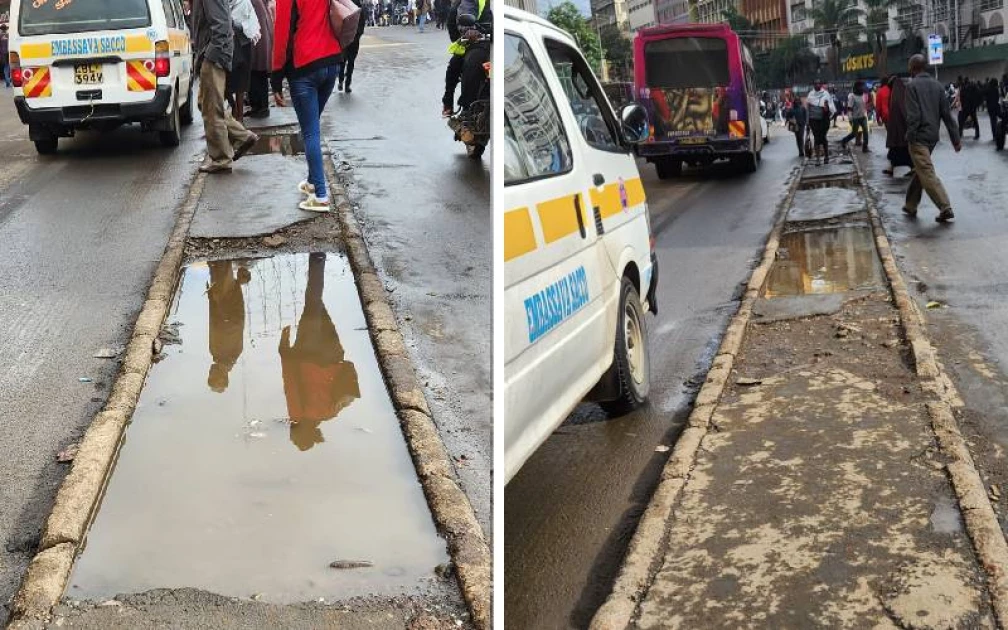
Motorists in Nairobi’s Central Business District (CBD) have raised concerns over the poor state of some roads, with large potholes making movement difficult and raising fears of damage to vehicles.
Footage recorded in Nairobi’s downtown area on August 27 showed several sections of the roads with large potholes filled with dirty water. Some of the potholes appeared rectangular, suggesting that repair work may have started but was later stopped.
Motorists expressed frustration over the condition of the roads, saying the situation was disappointing given the importance of the CBD to Nairobi’s economy.
They also questioned why some infrastructure projects appear to have stalled as political activity ahead of the 2027 General Election increases.
One motorist complained that residents and businesses were being forced to cope with roads that had deteriorated despite Nairobi being the country’s capital and main commercial centre.
The concerns are not limited to the CBD. Roads in areas such as Kilimani and Kileleshwa have also faced problems, particularly due to potholes, drainage challenges and increased construction activity.
In April 2026, Citizen TV journalist Immanuel Ndung’u drew public attention to the condition of Wood Avenue in Kilimani after sharing footage showing deep potholes along the road. He used a tape measure to demonstrate the depth of some of the damaged sections.
The footage showed rainwater collecting in potholes, with some sections measuring between 15 and 17 centimetres deep. The video triggered complaints from residents who blamed heavy construction vehicles and poor drainage for contributing to the deterioration of roads in the area.
Within days, Nairobi County crews moved to the area to work on drainage and preparations for road rehabilitation. Governor Johnson Sakaja also warned developers that construction trucks damaging roads could affect their occupation licences if they failed to address the damage.
The rehabilitation of roads in Nairobi has, however, faced several challenges. Some projects involving Nairobi City County and the Kenya Urban Roads Authority have experienced delays, with funding and payment issues affecting contractors.
Overlapping responsibilities between national and county agencies have also complicated some projects.
Busy roads such as Tom Mboya Street and Ronald Ngala Street present another challenge because they carry heavy pedestrian and matatu traffic. Construction work in these areas has to be carefully planned to avoid disrupting businesses and transport.
Road projects can also become more expensive when excavation exposes old water, sewer and electricity lines that need to be moved before rehabilitation can continue.
Despite these challenges, President William Ruto and Governor Sakaja signed a cooperation agreement at State House, Nairobi, for an Ksh80 billion infrastructure package. The programme includes plans to construct and rehabilitate 260 kilometres of roads and bridges.
For motorists, the focus now remains on seeing the promised infrastructure improvements translate into visible work on the ground.