

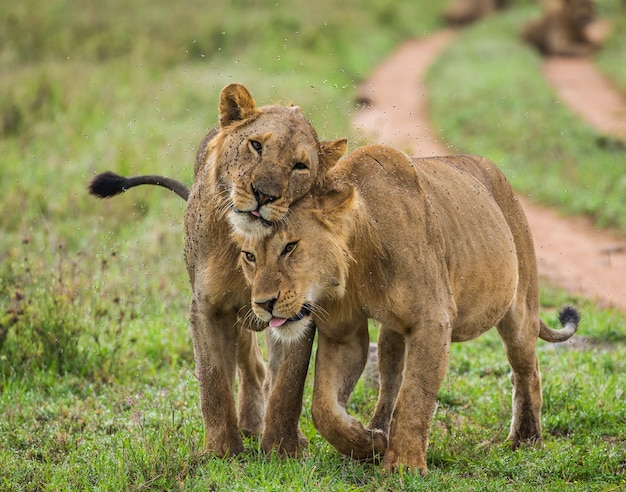
Residents of Rongai can now breathe a sigh of relief after a brief wildlife scare ended safely, with authorities confirming that two lionesses that had strayed into Sholinke Market were successfully captured and returned to their natural habitat. The incident, which happened on Wednesday, January 7, raised concern among traders and locals, but no injuries or damage were reported as a result of the encounter.
The Kenya Wildlife Service confirmed that the two lionesses had moved out of Nairobi National Park and into nearby human settlement areas before being traced and secured on the same day. According to KWS, the operation was swift and carefully handled to avoid panic and to protect both people and the animals involved.
Rangers moved quickly once reports were received from the community, ensuring the situation did not escalate.
KWS Lead Conservation Technology Officer Victor Matsanza revealed that the lions were captured and safely driven back to the pack. He explained that one of the lionesses had already been fitted with a tracking collar, which played a key role in locating them without delay. “Collaring involves fitting animals with ear tags and transmitters that use GPS or satellite technology to enhance surveillance and provide precise location data,” he explained.
The rescue mission involved KWS rangers, veterinary teams, and members of the Rongai community working together. Rangers carried out intense tracking operations, some of which continued overnight, both on foot and using vehicles. The teams had to be cautious while moving through populated areas to avoid causing alarm or putting lives at risk.
Matsanza emphasized that cooperation from local residents made a big difference in how fast the lionesses were found.
“Local communities and conservancy teams often provide vital early warnings and information about straying animals, facilitating quicker responses,” he stated.
He noted that such partnerships are important, especially for areas that border national parks where human and wildlife interactions are common.
During the operation, KWS also relied on modern conservation tools to improve accuracy and speed. Advanced systems like Earth Ranger were used to monitor movements and assess animal presence in different areas. This system is commonly used to determine animal populations in conservancies and helps rangers make informed decisions during emergencies.
In addition, drones were deployed to provide real-time surveillance over large sections of land. This approach helped teams track the animals without disturbing them and reduced the time needed to locate them. The use of drones has become more common in wildlife management due to their efficiency and safety benefits.
However, Matsanza pointed out that not all animals can be monitored this way due to high costs. Tracking collars are only fitted on selected lion prides and elephant herds, with each collar costing between Ksh800,000 and Ksh1 million.
“This means that not all animals within a conservancy can afford to be collared, which sometimes makes tracking difficult,” Victor added.
The two lionesses are now safely back with their pride, and KWS officers continue to monitor the area closely. The service has reassured residents that measures are in place to reduce similar incidents in the future, while also reminding communities living near parks to remain alert and report wildlife sightings promptly.