
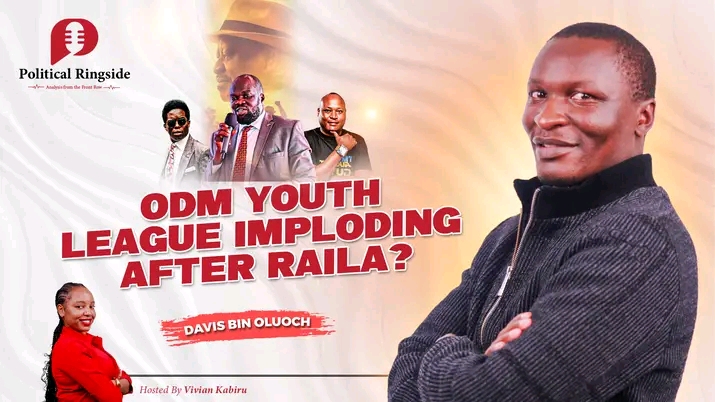
Political Ringside has become one of the spaces where serious conversations about the future of ODM are happening, especially at a time when the party is going through major changes.
With the passing of Raila Odinga, questions about leadership, direction, and inclusion have grown louder, and the political show has given room to voices from inside the party to speak openly.
One of these voices is Davis Bin Oluoch, a long-serving member of the ODM Youth League, whose views reflect the frustrations and hopes of many young people within the party.
In his discussion on the show, Oluoch explains that he has been actively involved in ODM work for several years.
He has helped develop important party documents and is currently contributing to a guide meant to support young people who want to run for political office. He says ODM has a very large support base, estimated at between five and six million members, and about three quarters of them are young people.
This matches the national reality, where most Kenyans are under the age of 35. However, he argues that these numbers are not reflected in decision-making, where young people are often pushed aside.
Oluoch points out that the ODM Youth League itself shows the problem clearly. He speaks about the current chairman, John Cura, noting that he has served in the role for more than 15 years. While he describes him as a decent and experienced individual, Oluoch believes the leadership has stayed too long and failed to adjust to the needs of today’s youth.
He adds that many people holding youth positions are actually above the age limit of 35, which goes against the basic definition of who a youth is. This situation, he says, creates silence and fear, where elected youth leaders cannot speak freely without being blocked by senior figures.
The exclusion of young people is also visible in the party’s top organs. According to Oluoch, slots meant for youth in bodies such as the National Executive Council and other key committees are often filled by older individuals. As a result, genuine youth voices are missing where important decisions are made. He compares ODM with other parties in Kenya and the region, noting that some have clearer systems for training and promoting young leaders through structured programs.
He also reflects on past efforts within ODM to bring in new faces, such as the “New Generation” initiative that was introduced years ago. That project aimed to prepare younger leaders for the future but was resisted by older members who were unwilling to share space or influence. Oluoch believes this resistance has slowed down renewal within the party.
Despite these challenges, he sees hope in the strength and resilience of young people. He refers to recent national events, including youth-led protests, as proof that young Kenyans have power and influence when they organize.
However, he says the lack of resources, such as a proper training academy for young members, continues to hold them back. He also criticizes the party for failing to include young people in government appointments, even when opportunities arose.
Oluoch believes the period leading to 2027 is critical. He says ODM needs a clear long-term plan, strong ideology, and deliberate investment in youth leadership. Without this, he warns, the party risks weakening over time.
Conversations like those hosted on Political Ringside help bring these issues into the open and keep pressure on political parties to listen to the voices that make up their largest support base.