

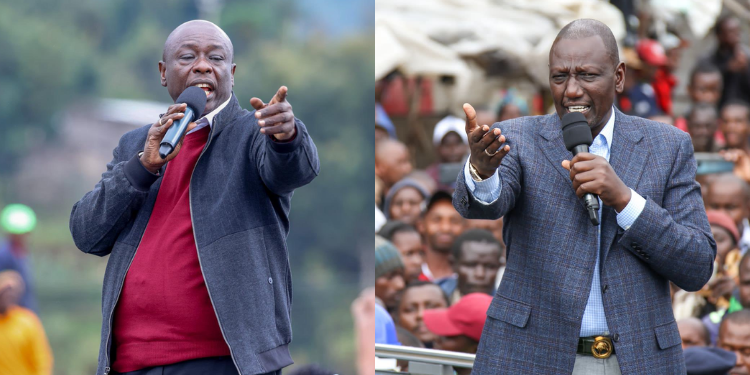
President William Ruto and his former deputy Rigathi Gachagua have intensified their public war of words in recent days, exchanging sharp personal accusations as the country moves closer to the 2027 General Election.
The latest round of attacks has drawn concern from religious leaders and observers who say the tone risks heightening political tensions.
During a tour of the Gusii region this week, President Ruto accused Gachagua of using his Democracy for the Citizens Party (DCP) to extract money from businesspeople, governors and political aspirants. Speaking in Kitutu Masaba, Nyamira County, Ruto described his former deputy as a “chief extortionist,” claiming that aspirants were required to pay large sums for party tickets or even for the chance to speak at rallies.
He alleged that amounts of Sh10 million or Sh20 million had been demanded from some gubernatorial hopefuls and that access to a microphone at DCP events came at a cost of Sh50,000. Ruto linked these alleged practices to the circumstances that led to Gachagua’s impeachment and removal from office in October 2024.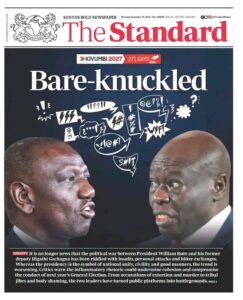
Gachagua responded with equally pointed criticism. He accused the President of recycling unfulfilled development promises in Kisii and Nyamira, stating that residents had seen little tangible progress on roads, water, electricity or other projects after four years. In one statement he declared: “I’m not a road in Kisii or Nyamira. Rigathi is not a water project. Gachagua is not an airport.”
He warned the President against interfering with DCP aspirants and referenced an earlier by-election win in Ol Kalou as a signal of his party’s growing strength.
The exchanges have not been limited to allegations of financial misconduct. Earlier this year the two leaders traded more personal and inflammatory remarks.
In one widely reported confrontation, Gachagua made comments about the President’s physical appearance that were widely interpreted as body-shaming. Ruto replied with a series of severe accusations, including claims that Gachagua was a “cold-blooded thief” and “cold-blooded murderer,” referencing alleged past wrongs involving family and property. Gachagua in turn raised historical grievances, including references to post-election violence and more recent protest-related deaths.
Nicknames have also become a feature of the rivalry. Ruto has referred to Gachagua as “Mr Texas” after the former deputy spoke of owning a home in the United States and suggested he might relocate there if Ruto secured a second term. Gachagua has used labels such as “Mr Six Months” and “Mr Taxes” in return. Tribal undertones have occasionally surfaced, with each side accusing the other of stoking ethnic divisions for political gain.
Religious leaders have voiced unease about the direction of the discourse. Clergy have warned that inflammatory language from senior figures could undermine national cohesion in the run-up to the election. Some civil society voices and analysts have argued that the focus on personal attacks distracts from substantive debate on cost of living, employment, public services and accountability.
The fallout between Ruto and Gachagua dates back to the period after the 2022 election. Once close political partners, their relationship deteriorated amid disagreements over power-sharing, regional representation and governance style, culminating in Gachagua’s impeachment.
Since then Gachagua has positioned himself as a leading opposition figure under the DCP banner, while Ruto has continued to campaign on his administration’s development record.