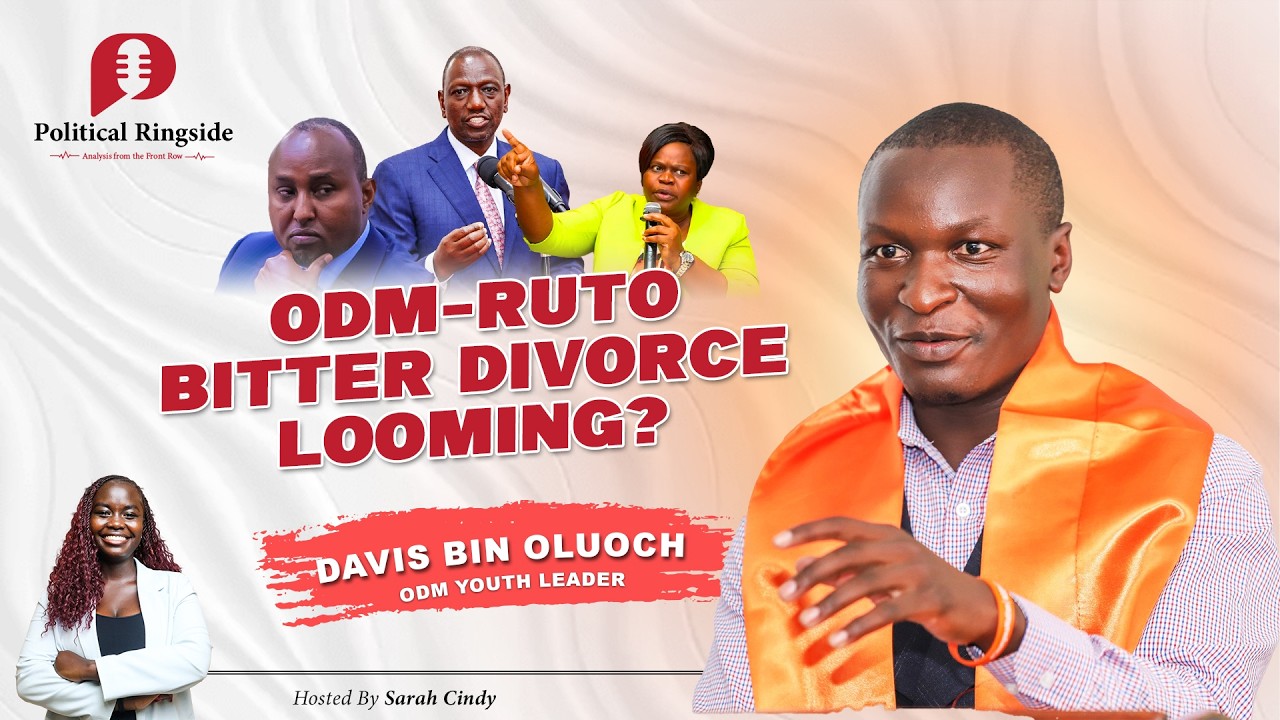
The recent episode of Political Ringside brought forward a detailed discussion on the working relationship between the Orange Democratic Movement and the government led by President William Ruto. Host Sarah Cindy spoke with Davis Bin Oluoch, who shared his perspective on the growing concerns about the stability of this political arrangement.
Davis began by explaining the history of ODM, noting that the party has played a major role in Kenya’s politics since 2005. He pointed out its involvement in key political moments such as the constitutional referendum that year and several general elections that followed.
However, the party now faces a different situation as it does not have a clear presidential candidate ahead of the next election. This has led to mixed views within the party, especially with some members supporting President Ruto for a second term.
The discussion then turned to the source of recent tensions. Davis linked this to the 2024 protests led by young people against the Finance Bill, which caused unrest across the country.
He explained that Raila Odinga later stepped in and helped reach an agreement with Ruto in March to calm the situation. This agreement included a 10-point agenda and saw ODM send some experts to work within government. Davis stressed that this was not a full political coalition but a temporary working arrangement meant to stabilize the country.
Concerns were raised about how this decision was made within ODM. The party’s National Executive Committee approved the move without broad consultation among its many supporters across regions like Kisumu, Mombasa, Narok, Samburu, Nairobi, and parts of Mount Kenya.
According to Davis, this lack of wider involvement has contributed to internal dissatisfaction.
There have also been claims that ODM is putting pressure on the government over political positions, but Davis rejected this. Instead, he said some ODM members who support the arrangement feel they are not benefiting enough, especially in terms of resources and influence.
There are fears that the ruling side could weaken ODM by attracting its members with promises of future election tickets.
Following the passing of Raila Odinga, divisions within ODM have become more visible. Members disagree on issues like leadership positions, zoning of seats, and the party’s direction after 2027. Davis noted that while differing opinions are part of democracy, unity is necessary once decisions are made.
A major concern remains the lack of a presidential candidate for 2027. Davis explained that this puts ODM at a disadvantage, especially in coalition negotiations. There are also reports that the ruling side plans to challenge ODM leaders in their strongholds, which could reduce the party’s influence.
To address these challenges, Davis suggested that ODM should focus on rebuilding its base. This includes strengthening grassroots support, investing in youth and women leadership, and preparing candidates through training in campaign skills and fundraising. He emphasized that choosing a presidential candidate early would give the party a stronger position moving forward.
On the balance of power, Davis acknowledged that the government currently holds more control due to its access to state resources and majority in parliament.
However, he argued that ODM still has strong national support and well-established structures. The ideal situation, he said, would be a fair partnership between both sides.
Davis spoke about ODM’s long-term goals, which include improving governance, education, healthcare, housing, and devolution. He noted that while some progress has been made, much work remains. He also stressed the importance of unity within the party, warning that divisions could weaken its future.
The discussion also covered zoning, which helps coalition partners avoid competing against each other in the same areas. Davis described it as a practical political strategy rather than a threat to democracy.