

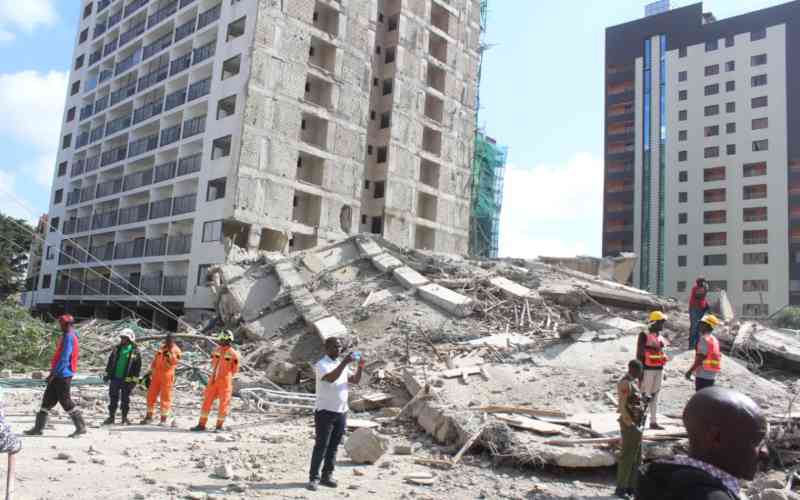
Authorities have intensified investigations into the collapse of a residential building in South C, Nairobi, as pressure mounts to hold all those responsible to account.
The incident has raised serious concerns about safety standards, illegal construction, and the role of professionals tasked with ensuring compliance with approved building plans. The government has now made it clear that severe action will be taken if wrongdoing is confirmed.
Speaking at the site on Monday, January 5, Lands and Housing Cabinet Secretary Alice Wahome said her ministry would not shield any professional found to have broken the law. She warned that architects and other experts involved in the project risk losing their licenses if investigations show they contributed to the collapse.
According to Wahome, professional accountability is critical in restoring public trust and preventing similar tragedies in the future.
Wahome explained that while the developer had received approval to build, the construction went far beyond what was allowed. The ministry had approved the building to rise up to 12 storeys only. However, the developer went ahead and added four more floors without approval, increasing the height to 16 storeys.
This major violation, she said, placed the structure under extreme risk and eventually led to its failure.
She further noted that quality assurance inspections had been carried out at different stages of construction, as required by law.
During these inspections, official records showed that the building had only reached the third floor. This raised serious questions about how the additional floors were added without detection or proper authorization. Wahome stressed that this gap would be a key focus of the ongoing investigations.
“At the time of the incident, the project was non-compliant on four additional floors that were never approved. That is the beginning of the problem, and our investigations will start from that point,” Wahome stated.
The Cabinet Secretary warned that all professionals who enabled the illegal construction would face individual responsibility. This includes architects, contractors, inspectors, and any other officers involved in approvals or oversight.
She added that the ministry is working with other agencies and professional bodies in a multi-sectoral team to trace every step of the project and establish exactly where failures occurred.
Her remarks came as Nairobi Governor Johnson Sakaja claimed the county government had repeatedly raised concerns about the building.
According to Sakaja, county officials had flagged the structure for non-compliance and issued enforcement notices, but the developer ignored them and continued building. The governor argued that counties should be given prosecutorial powers so they can directly take legal action against developers who break construction laws.
Sakaja also accused the Office of the Director of Public Prosecutions of failing to act, claiming that the ODPP declined to charge the developers even after the county sought prosecution. This accusation has added another layer of tension to the unfolding case.
The building collapsed on Friday, January 2, killing two people. One body has been recovered, while rescue teams continue searching for another person believed to be trapped under the rubble. The tragedy has left families grieving and residents fearful about the safety of buildings in the area.
In response, the ODPP directed the Inspector General of Police to investigate the collapse and submit a full report within seven days. The ODPP reaffirmed its commitment to the rule of law and promised that anyone found responsible would be held to account after investigations are completed.
“The DPP has directed the IGP to record statements from all relevant persons, including the developer and the contractor, and the persons responsible for the relevant building and construction approvals, inspections, and enforcement, and forward the resultant file for perusal and action within 7 days from the date hereof,” DPP stated in a statement on Sunday, January 4.