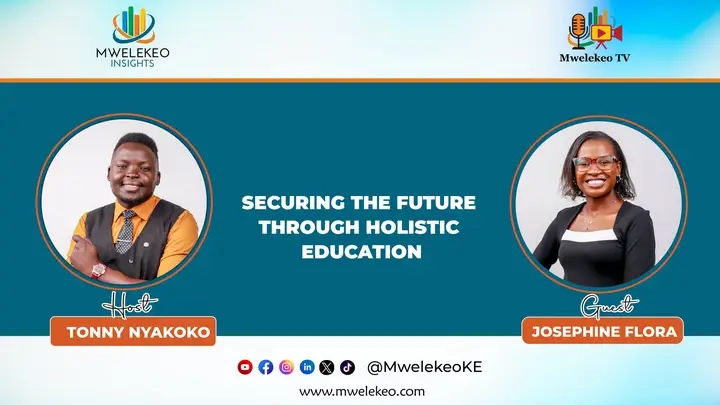
The recent episode on Mwelekeo TV clearly showed how a holistic education model can help vulnerable young people succeed, with the discussion guided by Mwelekeo Insights, a leading research firm in Kenya known for using data and real-life evidence to shape conversations on youth development in Kenya.
Produced by Mwelekeo Insights, the episode featured host Tony in an in-depth conversation with Josephine Flora, the founder and executive director of BrightPath Kenya, focusing on why education support must go beyond books and classrooms to truly change lives.
Josephine explained that her motivation comes from her own life story. She grew up in Kibera, one of Nairobi’s largest informal settlements, where many children start school with hope but never finish.
Poverty, early pregnancies, broken families, and lack of guidance push many students out of the system.
In her primary school class of 129 pupils, only about half managed to reach secondary school. Her situation became even harder in 2016 when her father was killed, leaving her without parents.
Despite this, she pushed on, completed her education, and later decided to support other children facing similar struggles. This journey led to the creation of BrightPath Kenya.
BrightPath Kenya focuses on supporting vulnerable but hardworking students. Josephine explained that the organization does not only offer scholarships.
Instead, it provides a full support system that includes mentorship, life skills training, emotional and mental health support, physical activities, and career guidance. Students are selected based on both need and commitment. They consider pupils who scored at least 250 marks in KCPE, not just top performers, because the belief is that many average students can do well if given the right support and environment.
The discussion highlighted how different challenges affect students in different regions. In places like Bungoma County, many families have been displaced, leaving children dealing with trauma that affects their learning.
In Nairobi’s informal settlements, problems such as unstable housing, drug exposure, and lack of role models are more common.
BrightPath works closely with community leaders, local organizations, and chiefs to understand these issues and respond in ways that fit each community. Josephine shared stories of transformation, including a 24-year-old university student from a displaced area who was once very shy but now wants to fight harmful practices like female genital mutilation and early marriage.
Another student, abandoned by her parents but scoring 396 marks in KCPE, dreams of becoming a doctor. There was also a boy who only focused on football but later began considering other career options after proper guidance.
Mwelekeo Insights played a key role in the conversation by stressing the importance of research in shaping effective education programs.
Josephine noted that there are still major data gaps around issues such as early pregnancies, drug abuse among boys, and rising cases of suicide among young people.
Without understanding the real causes, such as poverty, family breakdown, or gender-based violence, many interventions fail. She pointed out that some programs address symptoms instead of root problems, which means the same challenges keep repeating.
The discussion also questioned how some development and government programs are implemented. While policies like the Competency-Based Curriculum are well intentioned, Josephine said they are not always properly applied in schools.
University funding systems sometimes ignore genuine need or merit. BrightPath tries to work differently by focusing on quality rather than numbers.
Currently, they support about 333 students who go through a careful vetting process. Mentorship camps help students adjust to new environments, while pairing rural and urban learners encourages shared learning and understanding.
Monitoring progress is central to BrightPath’s work. The organization regularly checks on students through interviews, feedback sessions, and close observation. Mistakes are treated as learning opportunities, not reasons to abandon a child.
Funding remains a challenge, with many more students seeking help than the organization can support.
Josephine hopes to expand nationally, build strong alumni networks, and create free mental health support hubs. She also wants schools to have trained counselors rather than overloading teachers.
Through research-backed discussions by Mwelekeo Insights and practical action by organizations like BrightPath Kenya, the conversation shows how combining data with real human stories can help break cycles of poverty and give young people a fair chance to thrive.